

Clean Room
Clean room sandwich panels are specifically designed to maintain the highest hygiene and cleanliness standards. Their smooth, roll-free surfaces reduce dust and bacteria accumulation, while secure fastening prevents contamination. Fooladgharb manufactures high-quality polyurethane panels, 4–15 cm thick, with aluzinc or galvanized steel sheets (0.5–0.7 mm), ideal for clean rooms in hospitals, pharmaceutical and vaccine production, food processing, laboratories, and medical equipment workshops.

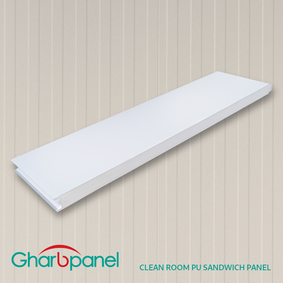

Features of Clean Room Sandwich Panels
-

Superior thermal insulation -

High durability -

Waterproof and weatherproof -

Fire resistance -

Acoustic insulation -

Quick and easy installation
Which Sandwich Panel is Best for a Clean Room?
PU sandwich panels are valued for their excellent insulation and versatility, making them ideal for chemical, food processing, and agricultural facilities. While they offer long-term energy savings, their higher cost makes them less suitable for livestock or poultry shed roofs.
Core thickness should be selected based on the required insulation level, as greater thickness does not always guarantee better performance—particularly when replacing corrugated sheet roofing.

Call for Advice
Laboratory and Clean Room Sandwich Panels
Fooladgharb’s clean room sandwich panels provide the flexibility to build facilities that maintain high cleanliness standards. They are ideal for applications such as temperature-controlled pharmaceutical storage, where precise temperature control is essential to preserve product quality and shelf life.
These standardized insulated panels deliver excellent structural and thermal performance. They feature smooth, dust-resistant surfaces, high resistance to wear and corrosion, and can withstand frequent cleaning. Common finishes include plastisol and stainless steel.
Our optimized joint system minimizes seams, reducing areas where dust and dirt can accumulate.

Which industries use clean rooms?
Clean rooms are essential in industries where even microscopic particles can affect product quality. They are widely used in pharmaceuticals, automotive, aerospace, food and beverage production, optics, electronics, biotechnology, and many other high-precision sectors. Without clean rooms, manufacturing many sensitive devices and products would not be possible.
What are the main characteristics of a clean room?
A clean room must have an advanced filtration and air conditioning system to supply fresh, contaminant-free air. Processes inside should be designed to minimize the creation of airborne particles. Personnel must wear specialized clothing that prevents the release of particles, and the clothing itself must not generate dust or fibers. All construction materials should be non-particle-generating, easy to clean, and compliant with strict contamination control standards.
How does a clean room work?
A clean room’s ventilation system not only delivers fresh air but also removes contaminants. Temperature, humidity, and pressure are carefully controlled using systems such as chillers, boilers, and hygienic air handling units. Air passes through multiple filtration stages, including HEPA or ULPA filters, to maintain the required cleanliness level.
What materials are suitable for constructing a clean room?
Materials for clean room construction should be lightweight, smooth, non-porous, easy to clean, chemically resistant, and airtight. Sandwich panels are widely used because they meet these requirements and provide excellent thermal and acoustic insulation. High-quality sandwich panels are manufactured with precision to ensure durability, hygiene, and compliance with industry standards.